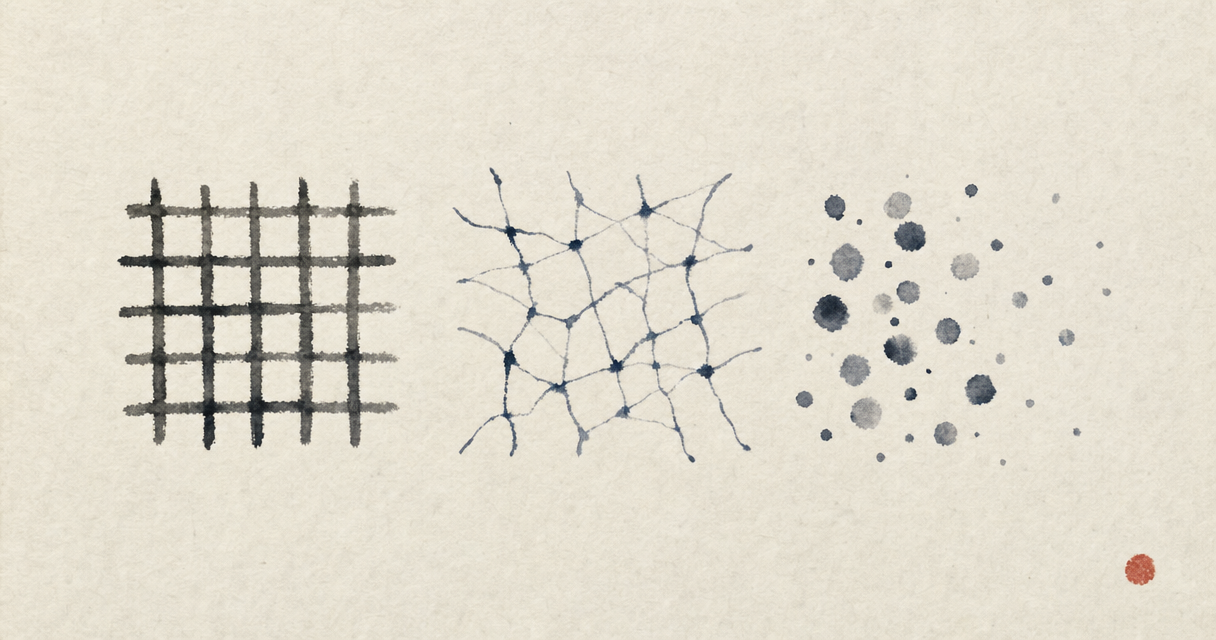
If you've ever searched for “how to organize notes” you've stumbled into a small holy war: some swear by PARA, some spend their evenings building their own Zettelkasten, some talk about a “second brain” as if it were all one thing. They're different methods, born for different problems. Before picking one — or discovering that you may need one less than you think — it's worth understanding what each of them does.
The problem isn't the app, it's the method
Switching notes apps every six months solves nothing: once the initial excitement wears off you're back in the same chaos, in a new interface. The reason is simple: the bottleneck isn't the tool, it's how you decide what goes where, and above all how you find things again later. That's where methods try to offer an answer.
PARA: organizing by action
PARA, created by Tiago Forte, splits everything into four categories: Projects (goals with a deadline), Areas (ongoing responsibilities, like “health” or “finances”), Resources (topics you're interested in) and Archives (what's finished). The strong idea is that a note shouldn't be classified by topic, but by how close it is to an action.
It's a pragmatic method, great for people who work in projects. The limit: it takes discipline to put everything in the right folder, and ideas that aren't tied to a specific project — the most creative ones — tend to all end up in “Resources”, which becomes a warehouse.
Zettelkasten: building a network of thoughts
The Zettelkasten (“slip box” in German) is the method of the sociologist Niklas Luhmann, who used thousands of interconnected cards to write an impressive number of books. The golden rule: each card holds a single idea, written in your own words, and is linked to other cards. The value isn't in the single note, but in the web of cross-references that forms over time.
It's the most powerful method for people who write and think non-linearly: connections make new ideas emerge. The limit is obvious to anyone who has tried it: maintaining the links by hand is an enormous amount of work. You have to remember what you've already written in order to link to it — and the more the archive grows, the harder that gets.
The second brain: capture everything, without relying on memory
The second brain isn't a filing method but a principle: offload out of your head everything that's worth keeping, so your mind is free to think instead of remember. PARA and Zettelkasten are two ways of giving that principle a structure. But the principle, on its own, says something important: the priority is capturing without friction, not classifying.
Which one to choose?
In practice: if you work in projects and want operational order, PARA. If you write a lot and love making ideas talk to each other, Zettelkasten. But both share the same hidden cost — manual work: deciding the folder, creating the links, maintaining the structure. And this is where something has changed in recent years.
If capture happens by voice and the connection between notes is automatic, much of the “method” stops being your job. That's the idea behind Itomori: you capture the raw thought — even just by speaking — and the intelligence indexes and connects notes by meaning, without asking you to remember where you put them. The Zettelkasten without the effort of keeping the threads by hand.
The honest answer
The best method is the one you can keep up on bad days, not just on the Sunday you reorganize everything. For most people, the most sustainable choice isn't a more rigid system: it's reducing the friction of capture and delegating the connections. Fewer rules to follow, more thoughts that stay — and talk to each other.