Every method for managing ideas follows the same story arc: two weeks of enthusiasm, a month of increasingly half-hearted maintenance, and then an abandoned archive that makes you feel guilty every time you open it. It's not your fault and it's not the method's fault: it's that almost all of them ask you to pay up front — structure, categories, discipline — and promise to give value back later. That "later" often never comes.
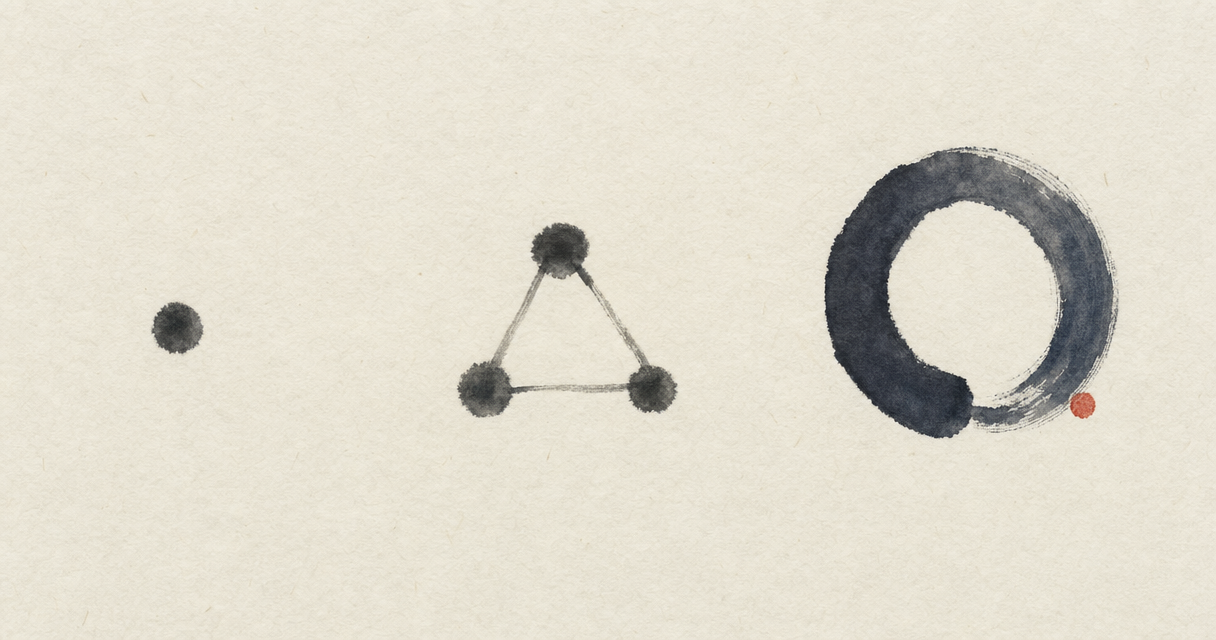
The 3Cs come from trying to reverse the order: value first, then (if ever) structure. They are three gestures — capture, connect, create — and their strength lies in the order, not the names.
1. Capture: no decisions at the point of entry
There's only one rule: nothing gets decided at the moment of capture. No folder, no title, no category. Just the idea, in.
It looks like laziness; it's design. Every decision required at the moment of capture is a small toll, and tolls get paid precisely when you have the least time — while you're walking, while you're leaving a meeting, while you're about to fall asleep. An archive that asks you to choose a folder before it has even received the thought is an archive that will receive very little.
That's why the natural gesture here is the voice: talking costs less than writing, and it lets you capture a thought while you're still thinking it, with all the hesitations and corrections. Going from voice to text isn't a tech gimmick: it's what brings the toll down to almost zero.
A detail that matters more than it seems: the raw transcript must be kept intact. It's the only version you can be sure of. Everything that comes after — summaries, rewrites, posts — is a derivative, and derivatives must never replace the original.
2. Connect: the work you shouldn't be doing
This is the step where classic methods ask for the most effort, and it's also where almost everyone gives up. In a Zettelkasten you stretch the threads by hand: every new note has to be linked to the old ones. It works beautifully for people with the discipline to do it — that is, very few.
The sustainable version is to flip it around: you don't link things, you're shown the notes that are close. By comparing meaning — not words — a note from today can turn out to be related to a voice note from April you'd forgotten you'd ever recorded. You don't need to remember what you titled it: it's the principle of search by meaning, applied to links instead of search.
There's still room for explicit intent, and it's worth defending: when you give two notes the same tag, you're saying something no algorithm can guess — that, to you, those two things belong together. The best connections come from the sum of the two: what you declare, plus what the machine notices.
3. Create: the step that gives meaning to the other two
It's the step almost no note-taking app takes, and to me it's the reason so many archives feel useless: an archive that never produces anything is just a warehouse with the illusion of productivity.
Creating means taking the raw material — a voice note, three scattered notes, the cluster of notes that have drawn each other together — and turning it into something finished: a post, the draft of an article, the email you've been putting off for weeks, the summary your team needs. I walked through a full practical example going from a voice note to a LinkedIn post.
There's a psychological reason too, not just a practical one. Capturing feels like wasted effort until it produces something; the first time a thought you spoke in the car becomes a text you actually publish, the gesture stops being a chore and becomes a habit. The third step is what keeps the first two alive.
Why three and not ten
You could add more phases — review, prune, archive, revisit. But every extra phase is another point where the system can break, and systems always break at the point that requires consistency.
Three gestures are easy to keep in mind, and above all two out of three require no discipline: capturing takes a few seconds, and connecting isn't something you do. The only moment your head is really needed is when you create — which, after all, is the only moment you should be using it.
If I had to boil it all down to one sentence: throw things in without thinking, let them talk to each other, and every so often pull something out. The rest is maintenance, and maintenance is precisely what makes you stop.