Product names are usually born from a brainstorm, a list of available domains and a compromise. Not Itomori. It was born from a film, a Japanese word and an image that stayed with me for years. Since it's such a personal choice, it's worth telling the whole story — not least because it explains, better than any technical description, what this app really does.
A name that comes from a film
The idea for Itomori came while watching “Your Name” (君の名は), the animated film by Makoto Shinkai. Without spoiling anything for those who haven't seen it: it's a story of bonds that cross time and space, of two people searching for each other without quite knowing why, and of a thread — literal and metaphorical — that keeps tying them back together.
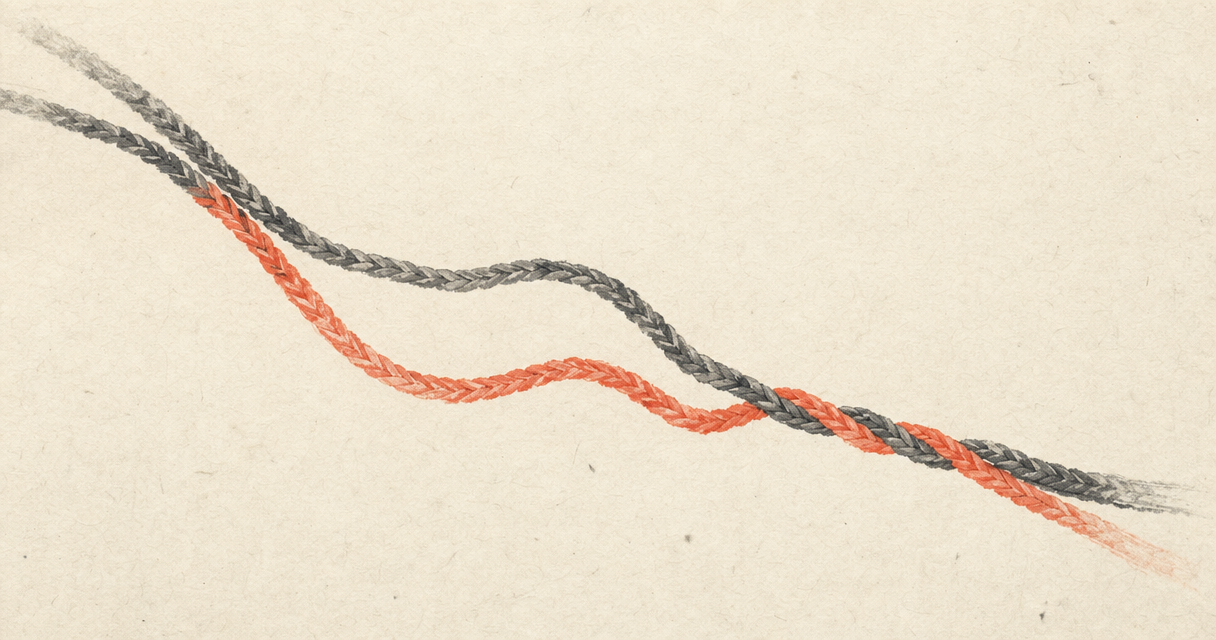
There's one image in particular that has never left me: a braided cord that tightens, loosens, comes apart and then joins again. That's where the name came from. And also a small personal tribute to Japan, a country I love and have been lucky enough to visit: the aesthetics, the care, the sense of empty space.
Itomori (糸守): the “keeper of threads”
Itomori is the name of the fictional town where much of the film takes place: a mountain village overlooking a lake, a place that keeps memories and traditions. The name itself is a small gem: 糸 (ito) means “thread”, and 守 (mori) means “to keep”, “to protect”. Literally: the keeper of threads.
For an app designed so you don't lose your thoughts — the thin threads of whatever crosses your mind during the day — I couldn't have asked for better. A name that already says what the job is: to hold, to keep, not to let the threads come undone.
Musubi: the braid that binds time, people and memories
One word keeps coming back in the film: musubi. It's the art of braiding the threads of kumihimo, the traditional Japanese cords knotted by hand. But in the story musubi is much more: it's the bond between people, the flow of time, the knot that ties who we were to who we are.
The image is simple and incredibly powerful. Threads move closer and further apart, sometimes they tangle, sometimes they separate entirely — but if they're meant to find each other, sooner or later they knot back together. The same goes for ideas: a thought you have today can connect to a note from six months ago that you had almost forgotten. The connection already existed; all it needed was something to hold it and show it to you.
It's exactly the opposite philosophy to filing things away. Not “put it away and forget it”, but “keep it, and let things talk to each other”.
From the threads of the film to the threads of your thoughts
This is where the link to the app clicks into place. Every thought is a thread: an idea spoken aloud while you walk, a note jotted on the fly, a sentence still in your head after a meeting. On its own, that thread almost always gets lost — not because it wasn't worth anything, but because it wasn't tied to anything.
Itomori does two things, in the right order. First it keeps the raw thread: your voice, transcribed and kept intact as the source of truth, with no rewrites that betray its meaning. Then it weaves: it connects that note to similar things you've already thought and shows you the pattern, the connections you wouldn't have noticed on your own.
Capture, connect, create: the three gestures of a second brain are, at heart, the same movement as musubi — gathering threads and knotting them together.
The mark: two threads that intertwine
The symbol comes from here too. Itomori's mark is two ink threads crossing in a soft knot — no brain icons, gears or microphones. When the app opens, the two threads “draw” themselves calmly and stay there, intertwined. It's a small detail, but it sums up the whole product in a single sign.
An Italian app with a Japanese soul
That aesthetic also shapes the way Itomori is made. There's a Japanese idea, ma (間), that refers to empty space, the pause: the space that gives meaning to what surrounds it, like the silence between two notes of music. Itomori tries to respect it: no bloated interfaces, no notifications, no red badges demanding attention. Just your thoughts, with room to breathe.
And then two concrete choices, not aesthetic ones: your language first, because your thoughts are in your language and deserve a tool that truly understands them; and serious privacy, with your data staying in the EU under the GDPR. Japanese soul, European heart.
Holding on to what slips away
There's another reason “Your Name” struck me so deeply, and it's the very heart of the film: the fear of forgetting. The protagonists fight not to lose a name, a face, a feeling that fades like a dream on waking. How often does this happen to us too, in small ways? A brilliant idea as you fall asleep, an insight in the shower, a perfect sentence said aloud in the car — and an hour later it's gone. We know something was there, but the thread has come undone.
Itomori was born precisely for this: to hold on to what slips away, at the exact moment it crosses your mind, without asking you to stop and write. The “keeper of threads” isn't a gentle metaphor: it's literally the app's job. You capture by voice in ten seconds, and you never lose that thought again — in fact, sooner or later it will resurface tied to something else, when you least expect it.
Why tell you all this
I could describe Itomori with a list of features. But you understand a product better from why it exists than from what it does. The why, here, is a film about bonds and an image — threads that find each other again — strong enough to become a name, a logo and a way of working.
If you want to see how the idea becomes a product, I've also told that story on the Product page. And if you're curious about the method, start with what a second brain is.